Key Takeaways
- Digital passes static in 2026. The World Out of Home Organisation forecasts digital at $28 billion, roughly 49% of global out-of-home spend, overtaking static formats for the first time.
- The US just had its first $3 billion quarter. OAAA reported Q2 2026 revenue of $3.16 billion, up 10.7%, with digital at 38.4% of the total and growing 18.5%.
- Programmatic is smaller than the discourse suggests. Programmatically traded DOOH was 8.4% of global digital out-of-home revenue in 2025, so direct relationships still govern the premium end of the market.
- AI brands are now an out-of-home category. Technology spend rose 139% in Q1 2026, with OpenAI, Genspark, Lambda and Vibe.co all new to the medium, tightening competition for premium placements.
- Dynamic creative is becoming table stakes. Weather, traffic and live-event triggers now activate without custom integration work per campaign.
- Attribution has closed the loop. Device ID matching against a control group produces incremental lift figures that hold up in a finance review.
- Placement is the differentiator again. When everyone has the same targeting technology, premium inventory is what separates a campaign from a commodity buy.
DOOH Is About to Outgrow Static for the First Time
Out-of-home spent decades filed under brand awareness. Buyers secured high-traffic boards, estimated circulation and hoped the sales curve moved. That version of the medium is gone.
The numbers explain why. In August 2026, the Out of Home Advertising Association of America reported that US out-of-home revenue rose 10.7% in the second quarter to $3.16 billion, the first time quarterly revenue has cleared $3 billion. Digital accounted for 38.4% of that total and grew 18.5% year over year, roughly double the rate of the medium overall. Globally, the World Out of Home Organisation’s 2026 expenditure report put out-of-home spend at $54.2 billion in 2025, up 15%, and forecasts digital reaching $28 billion in 2026, about 49% of all out-of-home and poised to overtake static formats for the first time.
That is not a format shift. It is a rewrite of how the channel gets bought, measured and judged. Here is what media buyers should be planning around heading into 2027, and where the technology stops being the deciding factor.
Programmatic DOOH Becomes the Default Buying Motion
Programmatic DOOH is the automated purchase of digital out-of-home inventory through demand-side platforms, using the same audience data and real-time bidding that governs display, mobile and connected TV.
The practical change is control. Direct buys locked advertisers into fixed screens for fixed periods, which meant a campaign that underperformed in week one still ran through week four. Programmatic activation lets buyers pause, shift and reweight mid-flight. If a transit hub is underdelivering on a Tuesday, that budget moves to an entertainment district before the week ends.
The interesting wrinkle for 2027 is how early this actually is. The World Out of Home Organisation puts programmatically traded DOOH at $2.1 billion globally in 2025, which is 8.4% of total digital out-of-home revenue. Programmatic dominates the conversation while representing less than a tenth of the money. Two things follow from that. Buyers who build the capability now are ahead of a field that mostly has not moved. And the direct relationship still governs more than 90% of spend, particularly for premium inventory that rarely reaches an open exchange at all.
AI Companies Have Become an Out-of-Home Category
The most striking line in the 2026 OAAA data is who is buying. Technology spending in out-of-home surged 139% in the first quarter of 2026, and the list of brands new to the medium that quarter reads like an AI funding announcement: OpenAI, Genspark, Lambda and Vibe.co all appeared for the first time. By the second quarter, technology and direct-to-consumer brands made up 30% of the top 100 out-of-home spenders.
There is a reason a category built entirely on digital distribution is buying physical media. AI products are competing for consumer trust in a market with no established brand hierarchy, and a company that exists only as a browser tab benefits enormously from occupying physical space in a city where its customers work. Out-of-home confers permanence that a performance channel cannot manufacture.
For media buyers planning 2027, this is a competitive signal. The premium inventory in major markets is being bid on by a well-funded category that did not exist as an out-of-home buyer three years ago. Lead times on the best placements are tightening accordingly.
Dynamic Creative Optimization Moves From Novelty to Baseline
Dynamic creative optimization lets a single campaign serve different creative depending on live external conditions, using HTML5 layers and API data feeds rather than a fixed video loop.
The triggers that have proven out are specific:
- Weather. A quick-service brand swaps iced coffee for hot chocolate the moment the local temperature reading drops below a set threshold.
- Traffic conditions. Automotive and audio brands serve longer-form creative when congestion data shows drivers are stationary and have time to read.
- Live results and events. Apparel brands trigger celebratory creative outside a venue within minutes of a home win.
What changed recently is friction. Media owners and platforms have built enough shared plumbing that activating dynamic creative no longer requires a custom integration per campaign. In 2027, running a static four-week loop on a premium digital asset will look less like a budget decision and more like a missed one.
3D Anamorphic and Experiential Formats Earn Their Own Distribution
Anamorphic 3D creative uses forced perspective to make imagery appear to leave the screen. It has become the most reliable way for a brand to buy a cultural moment rather than an impression count.
The value is not the spectacle itself. It is what the spectacle does afterward. A well-executed anamorphic placement in a high-footfall location becomes source material for organic social video, which extends a single localized buy into national and sometimes global reach at no additional media cost. The physical asset does the work of a production budget.
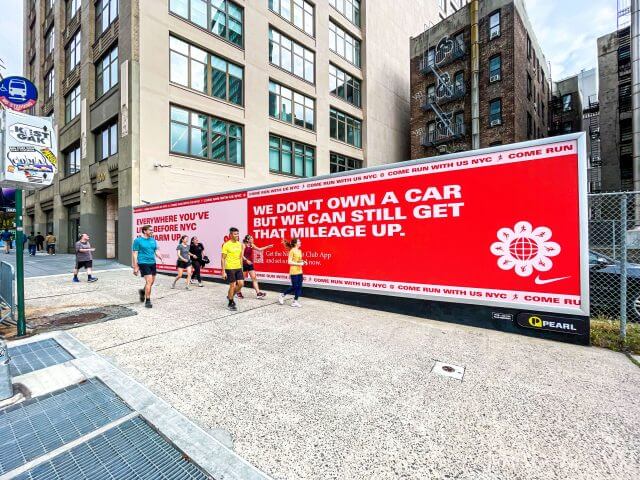
This is where format and activation converge. Pairing an unmissable digital display with a street-level experiential presence underneath it produces something a screen alone cannot: a reason for people to stop, participate and record. Pearl Media builds campaigns at that intersection, because the placement and the activation are the same creative decision.
Closed-Loop Attribution Finally Answers the ROI Question
The oldest objection to out-of-home was that nobody could prove it worked. That objection no longer holds.
Closed-loop attribution uses mobile ad ID matching and geofencing around each placement. When a device enters the viewshed of a screen while an ad is playing, that exposure is logged. Brands then retarget the exposed audience on mobile and social, and measure store visits, site sessions and completed purchases against a demographically matched control group that never saw the placement.
The result is an incremental lift figure that survives a CFO conversation. It also reframes what buyers should be comparing. Judging placements on cost per thousand impressions alone treats every impression as equal, when attribution data consistently shows that a captive pedestrian audience converts at a different rate than a passing vehicle.
Premium Inventory Separates From Commodity Screens
As DOOH hardware gets cheaper, commodity inventory floods in. Screens at fuel pumps, in elevator banks and above grocery checkouts now show up bundled inside programmatic buys. They deliver frequency. They do not deliver stature.
That gap is the strategic story of 2027. Sophisticated targeting applied to forgettable inventory produces precisely targeted forgettable advertising. The technology raises the floor for everyone, which means the placement itself becomes the differentiator again.
Brands launching products, entering markets or defending share need large-format inventory in environments that carry cultural weight: transit hubs, downtown cores and premium venues where the audience is concentrated and the environment is brand safe. Programmatic agility and monumental placement are not competing strategies. The best campaigns in 2027 will run both.
Plan Your 2027 Campaign
The channel that used to be measured in estimated circulation now runs on real-time bidding, live data triggers and verified attribution. What has not changed is that the strongest work still depends on where it runs.
Talk to our team about your 2027 plan, and we will map the inventory to it.