Key Takeaways
- Redefining the Canyon: In marketing, the Urban Canyon Effect describes how tall buildings restrict upward visibility, forcing consumer attention to the street level.
- The Physics of Sight: Pedestrians have a limited comfortable field of view (approx. 15 degrees upward). Ads placed above this zone in narrow streets are often ignored due to neck strain and navigation demands.
- Quality of Impression: Street-level media offers “unavoidable” exposure and greater intimacy compared to distant rooftop billboards, resulting in higher engagement and brand recall.
- Leveraging Congestion: The traffic density inherent to urban canyons increases dwell time, giving eye-level digital billboards and storefronts longer windows to convey complex brand stories.
- Strategic Geography: Success requires identifying “choke points” in key markets (NY, LA, SF) where pedestrian volume is high and vertical sightlines are restricted.
The Urban Canyon Effect: Why Dense Cities Demand Eye-Level Advertising
In the expanse of the American highway system, the billboard is king. Elevated high above the asphalt, set against an open sky, it commands attention from miles away. But as the landscape shifts from the open road to the dense, vertical architecture of major metropolitan centers, the rules of visibility change drastically.
For decades, advertisers assumed that “bigger and higher” equated to better visibility. However, in the concrete gorges of New York, San Francisco, and Chicago, this logic falters. This phenomenon is known as the “Urban Canyon Effect.” While meteorologists use this term to describe how skyscrapers trap heat and wind, forward-thinking content strategists and media planners are redefining it to describe how vertical infrastructure traps and channels human attention.
For bold brands seeking to make a significant impact, understanding the Urban Canyon Effect is not just an architectural curiosity; it is the key to unlocking ROI in the most competitive markets in the country. To dominate the city, you must stop looking up and start meeting your audience where they actually live: at eye level.
What is the Urban Canyon Effect in Advertising?
Scientifically, an urban canyon is a place where the street is flanked by buildings on both sides, creating a canyon-like environment that alters local weather patterns. In the context of Out-of-Home (OOH) advertising, however, the Urban Canyon Effect refers to the restriction of vertical sightlines caused by high-density construction.
When a consumer walks or drives through a dense urban corridor, the towering facades of skyscrapers create a visual tunnel. Unlike the suburbs, where the horizon is wide and the gaze can wander upward, the city forces the field of vision to narrow. The higher the buildings rise, the more the “sky” disappears from the pedestrian’s immediate consciousness.
This creates a paradox for traditional advertising. Rooftop billboards and high-elevation spectaculars, often priced at a premium for their size, frequently suffer from poor viewability in these canyons. They are physically present, but optically absent. The architecture effectively locks the consumer’s attention to the street level, creating a high-intensity zone of engagement within the first twenty feet of elevation. Brands that recognize this shift from “open sky” visibility to “tunnel” visibility are pivoting their spend toward street-level media, capitalizing on the very constraints that render high-elevation units ineffective.
The Physics of Attention: Why Looking Up is Hard
The preference for eye-level media in urban environments is not merely a stylistic choice; it is rooted in the biomechanics of human sight. The comfortable field of view for a pedestrian walking down a city street is generally considered to be between eye level and approximately 15 degrees upward. To view an advertisement placed on a rooftop or the upper façade of a ten-story building, a pedestrian must physically crane their neck, breaking their natural stride and posture.
In a leisurely environment, people might look up to admire the architecture. But in the bustling, high-velocity environment of a morning commute, pedestrians are focused on navigation. They are scanning for traffic, looking for subway entrances, and dodging other commuters. The tall buildings act like horse blinkers, physically and psychologically forcing consumers to focus strictly on what is in front of them.
This creates a captive audience at the ground level. Whether it is a tech executive rushing to a meeting in the Financial District or a fashion-forward consumer shopping in SoHo, their eyes are scanning the horizon line, not the skyline. Media placed within this natural “cone of vision” does not require the consumer to work to see it. It is frictionless. By aligning advertising placement with the physics of human attention, brands ensure their message enters the consumer’s consciousness without resistance.
Street-Level vs. Rooftop: The Battle for Visibility
When evaluating media inventory in dense cities, the distinction between “viewable” and “noticeable” is critical. A rooftop billboard may be viewable from three blocks away, but as the consumer approaches, the angle becomes too steep, and the ad disappears from view just as the consumer enters the critical engagement zone. This results in a fleeting impression that lacks intimacy.
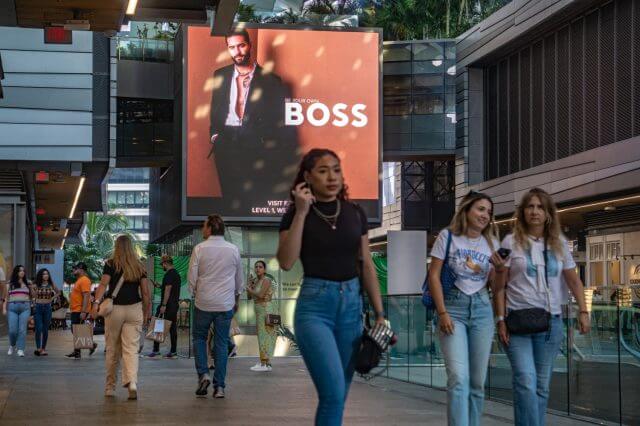
In contrast, street-level execution—such as Pearl Media’s premium street-level billboards and storefronts—offers a fundamentally different value proposition. These formats are designed for immersion rather than mere awareness. Because the ad unit sits directly in the consumer’s line of sight, the engagement is unavoidable. The distance between the viewer and the creative is measured in feet, not city blocks, allowing for more detailed storytelling and a stronger emotional connection.
This proximity transforms the advertising medium from a distant broadcast into a personal interaction. For data-driven marketers, this shift is justified by the quality of the impression. While a high-elevation unit might claim a high circulation number based on general traffic flow, street-level media captures high-intent traffic with a significantly longer dwell time. The audience isn’t just passing by; they are walking alongside the brand, often for several seconds, allowing the message to penetrate the noise of the city.
Leveraging the Canyon for High-Impact Campaigns
The very congestion that defines the urban canyon can be leveraged as an asset for advertisers. Traffic—both vehicular and pedestrian—is a side effect of density. In open environments, cars speed past billboards at 65 miles per hour. In the urban canyon, traffic moves slowly, often grinding to a halt at intersections and choke points.
This deceleration creates extended dwell times that are gold mines for brand exposure. A digital billboard positioned at eye level near a busy intersection doesn’t just get a glance; it gets a stare. Pearl Media’s digital inventory is engineered to capitalize on these moments of pause. With high-definition LED screens and dynamic capabilities, these units can deliver vibrant, motion-based content that entertains commuters stuck in gridlock or pedestrians waiting for a walk signal.
Furthermore, the aesthetic potential of the canyon allows for creative integration that traditional billboards cannot match. Storefront advertising, for example, transforms vacant retail spaces into massive, street-level canvases. This format appeals strongly to brands that value aesthetic excellence and immersive experiences. Rather than interrupting the view, the ad becomes part of the streetscape, wrapping the brand around the consumer’s daily environment. It turns a walk down the block into a brand journey, offering a level of “unavoidable” exposure that is perceived as architectural rather than intrusive.
Strategic Placement in Key Markets
Not all canyons are created equal. The efficacy of street-level advertising relies on strategic selection of inventory in high-traffic corridors where the canyon effect is most pronounced. This requires a nuanced understanding of urban geography—identifying the neighborhoods where pedestrian density is highest and vertical infrastructure is most imposing.
Pearl Media specializes in curating inventory in these exact locations. In markets like New York, Los Angeles, and San Francisco, the focus is on “choke points”—areas where transit hubs, retail districts, and commercial offices intersect. These are the arteries of the city where the flow of people is constant, but the visual field is constrained.
By securing premium real estate in these zones, brands can dominate the visual landscape. It is not about blanketing the city with low-value impressions; it is about owning the specific street corners and corridors where the target audience lives, works, and shops. Whether targeting the tech-savvy early adopter in San Francisco or the trendsetting creative in Brooklyn, the strategy remains the same: use the architecture of the city to funnel eyes directly to the message.
Conclusion & Strategic Takeaways
The Urban Canyon Effect is a reality of modern metropolitan life. As cities continue to grow vertically, the value of the sky diminishes, and the value of the street skyrockets. For advertisers, clinging to traditional, high-elevation media strategies in these environments is a fight against physics—a fight that yields diminishing returns.
To maximize visibility in dense cities, brands must lower their gaze to raise their ROI. By embracing street-level billboards, storefronts, and digital eye-level media, advertisers can turn architectural constraints into competitive advantages. It is time to move past the outdated tactic of shouting from the rooftops and start having face-to-face conversations with consumers on the ground.
Ready to dominate the street?
Contact Pearl Media to map your campaign to the most effective sightlines in the city, or view our Street Level Media Kit to see how we can bring your brand to eye level.